


About the Little Giants Program
The term ‘Little Giant’ (小巨人) is an official Chinese government designation given to selected small and medium-sized enterprises (SMEs) as part of Beijing's drive to build self-sufficiency in key designated technologies. These companies receive preferential government support.
The Little Giants program is aimed at reducing China’s dependence on specific foreign technologies by developing local alternatives, and increasing foreign reliance on Chinese suppliers in sectors where Beijing seeks strategic advantage.
The Little Giants Tracker provides visibility into the Little Giants program. Unlike China's well-known technology giants such as Huawei and Alibaba, Little Giants keep a low profile. They tend to operate in niche areas that fall outside the reach of investment controls, partnership checks, and other measures designed to limit unintended knowledge and technology transfer. Yet they are central to China's long-term ambition to secure its place at the heart of global supply chains across a range of critically important technologies and sectors.
Little Giant status signifies that China’s Ministry of Industry and Information Technology has formally assessed a company as possessing specialised technological capabilities, a strong position in a niche market and relevance to national industrial priorities. While foreign governments, businesses and universities have concentrated scrutiny on globally recognised companies such as Huawei and Alibaba, Little Giants are generally smaller, less visible and more deeply embedded in specialised supply chains. This lower profile increases the likelihood that they escape investment screening, partnership due diligence and other safeguards intended to prevent unintended transfers of sensitive knowledge and technology.
The programme is an important instrument for implementing the industrial ambitions associated with Beijing’s Made in China 2025 strategy and China’s broader drive for technological self-reliance. Its strategic significance extends beyond direct state assistance. Government designation acts as a powerful certification mechanism, signalling political support and commercial credibility to investors, lenders, customers and local authorities. The resulting combination of public support and private capital can create self-reinforcing competitive advantages, enabling firms that initially occupy narrow technological niches to become indispensable suppliers and, over time, sources of structural foreign dependency.
Status is not permanent: companies undergo triennial review and can be decertified if they fail to maintain qualifying performance. Successful companies can be elevated to 'Hidden Champion' status — mid-size firms designated as established global market leaders in their niches, and expected to dominate international supply chains in their technology area. Drawing on ASPI's curated dataset of company-level patent filings, the China Little Giants Tracker enables systematic technology exposure analysis at a scale and granularity that research has not previously made available.
Broader Context
While many governments seek to support local industry through a range of incentives, the distinction is that those governments generally maintain a market-driven approach to their technology sectors. While such governments may provide research funding, tax incentives or targeted subsidies, their efforts are typically more transparent, limited in scope and not directly tied to state intelligence objectives, creating levers of coercion or military modernisation programs. That distinction highlights the unique risks posed by China’s approach as it combines aggressive state-backed industrial policies with a lack of separation between private enterprise and government control in support of Beijing’s regional and global agenda.
The Little Giant eligibility criteria have evolved through several official notices since the programme was first established in 2018. The 2018 launch criteria, the 2022 unified national framework and the 2026 revised framework are the three principal benchmarks for the Little Giants program, although intermediate batch notices also adjusted individual requirements and thresholds.
Across these benchmarks, five recurring substantive criteria have been identified:
- Focus — sustained, deep specialisation in a single narrow segment or product line. Companies must demonstrate a track record of successfully operating in niche markets.
- Market standing — a leading, recognised position within that niche: demonstrated market share, brand recognition and sectoral influence. In practice, this means a company should be capable of monopolising or mastering key-core technologies within its field.
- Innovation — technical depth evidenced by R&D investment, a qualifying intellectual property portfolio (particularly patents), and participation in standard-setting.
- Strategic relevance — active operation in a state-prioritised technology domain and/or a critical position in a domestic or global supply chain. This criterion directly connects Little Giant selection to China's broader industrial policy goals, including Made in China 2025 and the 14th Five-Year Plan targets for high-tech manufacturing.
- Business quality — financial health (revenue scale, growth trajectory, leverage ratios) combined with management maturity, including governance standards and digitalisation capability.
Two further requirements function as pass/fail gates rather than graded criteria:
- Since 2022, the firm must already hold recognition as a provincial-level specialised and sophisticated SME (专精特新中小企业) — the tier below national Little Giant status in China’s innovation cultivation hierarchy.
- The firm must carry a clean compliance record, with no serious safety, quality, environmental, credit or tax violations in the preceding years.
Under the 2022 and 2026 frameworks, these requirements should not be read as a points-based system: applicants are generally required to satisfy all applicable threshold criteria, not merely accumulate sufficient scores across them. The 2026 framework introduced an additional minimum development-quality score as a further pass/fail condition.
Little Giants are selected annually in batches by China's Ministry of Industry and Information Technology (MIIT). The selection process has undergone a significant structural change over its history that affects how the Tracker's data is sourced and verified.
Batches 1–3 (2019–2021) were announced centrally by MIIT as a single national list, without identifying which sub-national authority had nominated each company. From Batch 4 (2022) onwards, the process was decentralised: each of the 37 nominating authorities — provincial governments, autonomous region administrations, provincial-level municipalities and independent planning cities — announces its own list of successfully nominated companies. This decentralisation means that for Batch 4 onwards, the Tracker is able to identify the nominating authority for over 99.5% of listed companies, providing users with a clear line of sight to the sub-national government body that endorsed each firm.
Since Batch 1 in 2019, seven rounds have been completed. Batch 8 is expected in late 2026 and will be incorporated into the Tracker promptly upon release. The scale of the programme has grown substantially: from 248 companies in the inaugural 2019 batch to a peak of 4,357 in 2022, reflecting Beijing's accelerating push to cultivate SMEs capable of mastering critical technology chokepoints.
Selection is not a one-time event. Companies are subject to triennial review, and those that pass continue under the Little Giant designation for a further three years. Companies that fail review lose their status, though they may be renominated in subsequent rounds. This means the Tracker's database distinguishes between Active, Inactive, and — where review data is incomplete — Unknown status, so users can assess not just which companies have been designated but whether that designation is currently in force.
Nominating authorities are the sub-national government bodies responsible for identifying companies within their jurisdiction that meet the Little Giant criteria and formally nominating them to MIIT for national-level designation. As the provincial or municipal department responsible for industry and information technology in that administrative unit they are, in each case, the local equivalent of MIIT.
There are 37 nominating authorities in total:
- 22 provincial authorities
- 5 autonomous region authorities (Guangxi, Inner Mongolia, Ningxia, Tibet and Xinjiang)
- 4 provincial-level municipality authorities (Beijing, Chongqing, Shanghai and Tianjin)
- 5 independent planning city authorities (Dalian, Qingdao, Ningbo, Shenzhen and Xiamen)
- 1 authority for the Xinjiang Production and Construction Corps (the Bingtuan)
Understanding the nominating authority matters for due diligence. A company's nominator establishes its primary regulatory and political relationship with the Chinese party-state at the sub-national level. Nominating authorities do not merely process paperwork: they are actively involved in identifying and cultivating firms that can advance state industrial policy priorities within their jurisdiction, providing financing, regulatory support and guidance throughout the process. Where a nominating authority carries particular sensitivity — such as those administering Xinjiang, where concerns about forced labour and human rights abuses are well documented — that context is directly relevant to any risk assessment of the companies they have nominated.
The Tracker identifies the nominating authority for over 99.5% of companies designated from Batch 4 (2022) onwards.
The programme launched in 2019 with Batch 1, which designated 248 companies. Seven rounds have now been completed, with Batch 7 announced in 2025. Batch 8 is expected in late 2026 and will be incorporated into the Tracker promptly upon release.
The programme has grown substantially in scale and ambition over this period. Annual designations peaked at 4,357 companies in Batch 4 (2022), reflecting the acceleration of Beijing's push to cultivate SMEs capable of overcoming what it has identified as 1,047 technological chokepoints in China's indigenous industrial base.
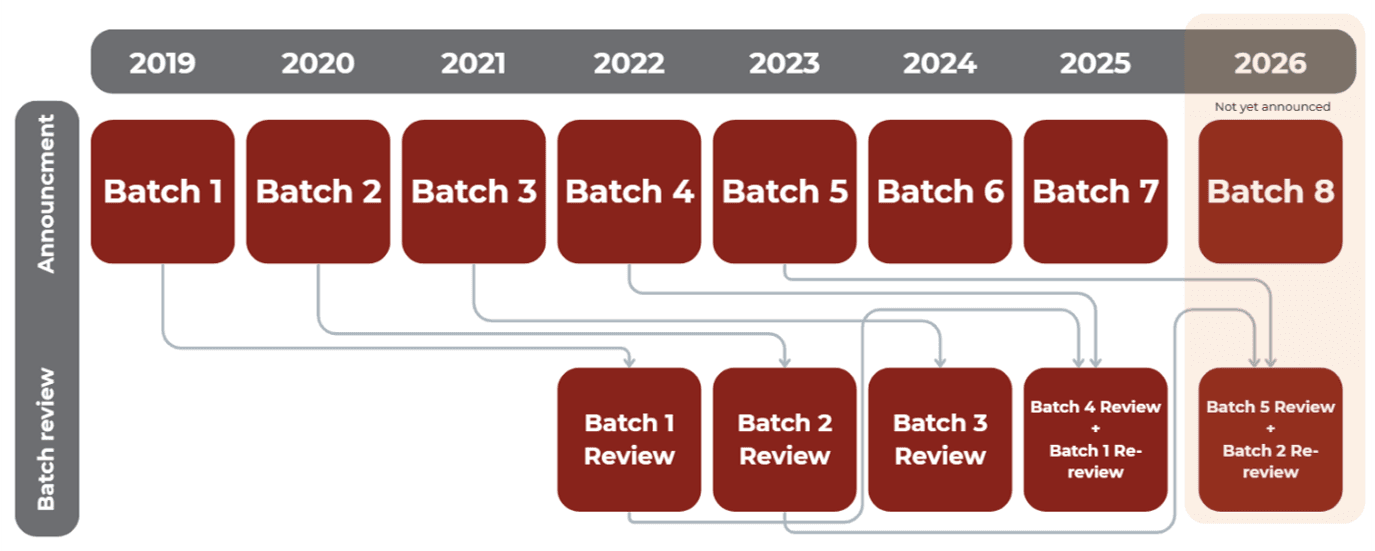
The programme operates on a rolling basis. Companies are subject to triennial review, meaning a designation from Batch 1 (2019) would first come up for review in 2022, and again in 2025. This rolling structure means the Tracker's database at any point in time reflects a mix of newly designated, actively maintained, and lapsed designations — all of which are tagged accordingly to ensure users can distinguish current from historical status.
Yes. Little Giant status is not permanent. It is subject to triennial review, and companies that fail to meet the programme's ongoing requirements are decertified and lose access to the preferential government support — financing, subsidies, regulatory facilitation and state collaboration — that designation confers.
Grounds for decertification include: a mismatch between the company's technology focus and the state-identified chokepoint priorities it was designated to address; insufficient product competitiveness within the designated niche; and failure to maintain a qualifying patent portfolio aligned with those chokepoint technologies. The patent alignment ground is particularly significant: it reflects that the programme's purpose is not to reward innovation in general but to advance specific state-defined technological objectives. A company that pivots away from its designated technology area — or fails to sustain meaningful IP development within it — risks losing its status regardless of its broader commercial performance.
Decertification is not uncommon. Of the 1,744 companies designated in Batch 2 (2020), only 1079 retained their status through the 2023 review — a removal rate of approximately 38.1%. This attrition rate is itself a signal worth monitoring: it indicates that the Chinese Government takes the programme's strategic alignment requirements seriously and is willing to withdraw support from companies that no longer serve its industrial policy objectives.
Companies that successfully navigate the review cycle and demonstrate sustained outperformance can be elevated to 'Hidden Champion' status — a higher-tier designation for mid-size enterprises that have achieved established global market leadership in their niche and are expected to dominate international supply chains in their technology area.
Because reviews are triennial rather than annual, each review batch encompasses companies from multiple earlier cohorts. The 2025 review, for example, covered Batch 4 companies (designated in 2022) alongside Batch 1 firms that had already passed their 2022 review. The figure below illustrates this overlapping cycle.
What this means for Tracker users:
The Tracker deliberately distinguishes between Active, Inactive and — where review data is incomplete — Unknown status for every company in the database. Companies that have lost their designation are retained in the database and tagged as Inactive rather than removed, ensuring users have a complete picture of which firms have been through the programme and what the outcome was. Where review data has not yet been published or cannot be confirmed, status is tagged as Unknown, affecting less than 3% of companies that have undergone review.
For ease, the figure below visually represents the accreditation cycle to date.
About the China Little Giants Tracker
The current Beta release features Batch 7 (2025), the most recently announced cohort of national Little Giants. Batches 1–6, covering designations from 2019 through 2024, are scheduled for inclusion at full product launch later in 2026. Batch 8 is expected to be announced by the Little Giant nominating authorities in late 2026 and will be incorporated into the Tracker promptly upon release.
The Beta release is deliberately scoped to Batch 7 to allow subscribers to evaluate the Tracker's analytical methodology — including the technology exposure rating and exposure profile — against the most current cohort of state-designated firms. Batch 7 alone comprises 3,482 companies across China's full geography and technology landscape, providing a substantive and analytically rich dataset for assessment and due diligence purposes.
At full product launch, the complete database of nearly 20,000 unique companies spanning all seven batches will be available, enabling longitudinal analysis across the programme's full history — including tracking which companies have been designated, reviewed, retained, decertified and in some cases renominated across multiple rounds.
No. The Tracker covers national-level Little Giants only. To understand why this boundary was drawn, it helps to understand where national-level Little Giants sit within China's broader SME cultivation hierarchy.
Beijing operates a multi-tiered system for identifying and supporting high-potential SMEs. At the base are provincial-level 'innovative SMEs’ (创新型中小企业) — firms recognised by their local authority as having meaningful specialisation and innovation potential within their sector. Above them sit provincial-level 'specialised, sophisticated, distinctive and innovative' SMEs (专精特新中小企业), which demonstrate stronger technical depth and market position. National-level Little Giants represent the top tier: firms that have been assessed by MIIT as having the capability to master or monopolise critical technology chokepoints at a national and ultimately global level. Since 2022, achieving provincial-level 'specialised, sophisticated, distinctive and innovative' recognition is itself a mandatory gateway requirement for national-level Little Giant nomination — meaning every post-Batch 4 company in the Tracker has already cleared the lower tiers before being assessed at the national level.
This tiering matters for users. A company appearing in the Tracker has not simply received a local government endorsement: it has been formally assessed by China's central industrial policy authority as strategically capable in a technology domain Beijing has prioritised for self-sufficiency. The analytical and due diligence significance of that designation is qualitatively different from provincial-level recognition.
The provincial tier is substantially larger: the Tracker’s current scope of national-level Little Giants includes over 19,000 unique companies. The population of provincial-level specialised SMEs runs into the hundreds of thousands. Including that tier would materially dilute the Tracker's signal-to-noise ratio and shift its focus away from the firms of greatest strategic and due diligence relevance. The Tracker's scope is deliberately calibrated to the tier where state-directed technological ambition is most concentrated and most consequential.
Inclusion in the Tracker means a company has been formally designated by the CCP as strategically capable in a technology domain Beijing has identified as a national priority for self-sufficiency. That designation is not simply honorary: it reflects a government assessment that the company can master or monopolise a critical technology chokepoint, and it comes with access to preferential state financing, direct subsidies, regulatory facilitation, and structured collaboration with state research institutions. In short, a Tracker company is one Beijing has chosen to back, guide and hold accountable to industrial policy objectives.
Designation does not, by itself, establish civil-military fusion involvement or malign activities.
Analytical categories for structured assessment. ASPI's research on Little Giants applies six categories to structure risk and opportunity assessment. These are not mutually exclusive — a single company may be relevant across more than one:
- Civil–military fusion — companies with substantive connections to China's military modernisation programme, including procurement relationships with the People's Liberation Army, ties to defence-affiliated universities or research institutes, or participation in state programmes that explicitly integrate civilian and military technological development. Beijing Zhongke Haixun Digital Technology Co. Ltd. (北京中科海讯数字科技股份有限公司), for example, supplies sonar and underwater acoustic systems directly to the PLA Navy, Coast Guard and Marine Corps — a relationship that exemplifies civil–military fusion operating through a nominally private Little Giant.
- Due diligence — companies with previously undisclosed connections to the party-state or involvement in undisclosed malign activities. Shanghai Wingtech Electronics Technology Co. Ltd. (上海闻泰电子科技有限公司) illustrates the risk: a Batch 3 Little Giant whose 2018 acquisition of Dutch semiconductor manufacturer Nexperia subsequently enabled the flow of microchip components into Russian weapons systems, raising sanctions compliance concerns across multiple jurisdictions.
- IP protection — companies presenting a heightened risk of intellectual property exposure to a state-backed entity. This risk is particularly acute where a Little Giant has established joint ventures, technology-transfer agreements, or controlling stakes in foreign firms — as illustrated by the 2019 acquisition of a controlling stake by Shanghai GeneoDX Biotech Co. Ltd. (上海捷诺生物科技股份有限公司) of Dutch molecular diagnostics company PathoFinder, through which it gained access to critical fungal detection technologies.
- Predictive SME trajectory — companies approaching a significant status transition: either at risk of decertification (due to technology-focus drift, declining competitiveness, or insufficient patent alignment) or on a trajectory toward Manufacturing Champion elevation. Tracking trajectory enables users to anticipate changes in a company's strategic posture and state support level before they are formally announced.
- Discovery — emerging firms advancing into global technology niches below the threshold of standard export control or investment screening processes.
- Emerging advantage — companies developing structural market dependencies in critical technologies that could translate into foreign leverage over time. Beijing Galactic Energy Aerospace Technology Co. Ltd. (北京星河动力航天科技股份有限公司), which produces small and medium launch vehicles with both commercial and civil–military applications, exemplifies a firm building the kind of sovereign capability in a critical domain that democratic governments will find progressively harder to exclude from their supply chains as it matures.
Using the Tracker alongside ASPI's other datasets:
No single data source is sufficient for a complete risk picture. The Tracker's technology exposure ratings and patent-based analysis should be used in conjunction with ASPI's China Defence Universities Tracker (CDUT) — which maps connections between companies and China's defence-affiliated academic institutions — and the Critical Technology Tracker (CTT), which provides ASPI's authoritative assessment of China's research leadership across 74 critical technologies. Together, these three datasets allow users to move from a company's presence in the Tracker, to its technology focus area, to its institutional relationships, building a layered and defensible analytical assessment.
The China Little Giants Tracker is built on three primary data sources, each serving a distinct function in the dataset's construction.
1. Official Little Giant company lists
The foundation of the Tracker is a consolidated set of Little Giant announcement and review lists, collected through systematic desktop research across all seven completed batches (2019–2025). These lists include initial designation announcements, triennial review outcomes, and company name updates — which are typically published together and are cross-referenced to maintain an accurate and current record.
Where official government sources are available — principally MIIT announcements and nominating authority publications — these are prioritised. Supplementary online sources are used where official records are incomplete or inaccessible. All lists are cross-checked against one another to confirm accuracy and identify inconsistencies.
A structural feature of the source data shapes the Tracker's coverage in one important respect: Batches 1–3 (2019–2021) were announced centrally by MIIT without attribution to individual nominating authorities, while Batch 4 onwards carries nominating authority identification. This means nominating authority data is available for over 99.5% of companies designated from Batch 4 onwards, but cannot be verified from announcement lists alone for the earlier batches.
2. Google Patents
Google Patents is used for initial identification of English-language identities of Chinese companies — a non-trivial challenge given the variation in how Chinese firms transliterate and render their names in international patent filings. This matching process is essential for linking Chinese company records to their international patent activity and ensuring the Tracker's data is usable by non-Chinese-speaking analysts and institutions.
3. Derwent World Patents Index (DWPI)
The Derwent World Patents Index is the primary source for building each company's patent portfolio — the analytical foundation for the Tracker's technology exposure ratings. DWPI is one of the world's most comprehensive patent databases, covering filings across major patent offices globally, and aggregating the standardised Cooperative Patent Classification (CPC) codes that the Tracker uses to map each company's patent activity to ASPI's Critical Technology Tracker taxonomy.
The quality and depth of a company's patent portfolio data directly determines the reliability of its technology exposure rating and exposure profile. Companies with larger, well-documented patent portfolios will carry higher-confidence technology exposure scores; companies with few or no identifiable patents are included in the database but with correspondingly limited analytical output. The FAQ entry on companies with no identifiable patents sets out how these cases are handled.
The China Little Giants Tracker uses the technology taxonomy developed by ASPI’s Critical Technology Tracker. This is available here. For each technology in that taxonomy, an AI model was used to iteratively identify Cooperative Patent Classification (CPC) codes relevant to it. The mapping for advanced optical communication, for example, includes codes such as:
- H04B10/00 — Transmission systems employing electromagnetic waves other than radio-waves (e.g. quantum communication)
- H04J14/00 — Optical multiplex systems
- H01S5/00 — Semiconductor lasers
- G02B6/00 — Light guides (optical fibres and waveguides)
Where a mapping ends in ‘/00’, it captures the whole CPC group, including every more specific subgroup underneath it. For example, H04B10/00 is the parent group for non-radio-wave transmission systems; specifying it picks up all the subgroups beneath, such as H04B10/2519 (fibre Bragg gratings). Where only part of a group is relevant to a technology, the specific subgroups are listed instead of the group.
The number of CPC codes assigned to a technology varies considerably. The densest mapping is advanced integrated circuit design and fabrication with 26 codes, while the sparsest is gravitational force sensors with a single code (G01V7/00 – Measuring gravitational fields or waves). These counts reflect codes that are explicitly listed; mappings that specify a group implicitly cover many more codes through its subgroups.
Cooperative Patent Classification (CPC) codes are the standardised tagging system used by patent examiners to categorise patents by technical field. Developed jointly by the European Patent Office (EPO) and the United States Patent and Trademark Office (USPTO), the CPC system is a more granular extension of the International Patent Classification (IPC), the treaty-based system administered by the World Intellectual Property Organisation (WIPO) that serves as the universal classification standard. We classify patents against our technology taxonomy using CPC rather than IPC because its finer resolution and continuously updated scheme distinguish emerging and critical technology subfields more precisely than the broader IPC categories, which are often too coarse to separate the technologies of interest.
CPC symbols for Chinese patents in this dataset are not assigned by CNIPA, which applies CPC only to a subset of its publications. They are drawn from Derwent World Patents Index, which aggregates classifications from the issuing offices and from the EPO's classification of Chinese patent documentation, propagated across the patent family.
When a patent is filed and examined, examiners assign one or more CPC codes reflecting the technical areas the invention relates to. A single patent routinely carries multiple codes — a sonar system patent, for example, might be tagged across signal processing, underwater acoustics and materials science. This multi-code structure means that a company's full CPC profile, aggregated across its entire patent portfolio, provides a granular map of its technological activity that is more precise and more defensible than self-reported technology descriptions or sector classifications.
The CPC system comprises approximately 250,000 codes organised in a hierarchical structure: nine top-level sections (A through H, plus Y for emerging cross-sectional technologies), subdivided into classes, subclasses, groups and subgroups. The hierarchy runs from broad to highly specific — a top-level group code such as H04B10/00 (transmission systems using electromagnetic waves other than radio waves) encompasses every more specific subgroup beneath it, while a subgroup code such as H04B10/2519 identifies a precise technical configuration within that family.
Why CPC codes matter for the Tracker
The Tracker's technology exposure ratings are built on CPC codes. For each of the 74 critical technologies in ASPI's Critical Technology Tracker taxonomy, ASPI has identified the specific CPC codes that define activity in that technology. A company's patent portfolio is then analysed against these mappings: the proportion of the company's CPC codes that fall within a given technology's definition determines its alignment score, which feeds directly into its technology exposure rating.
This approach is grounded in examiner-assigned classifications rather than company self-description, making it resistant to the kind of strategic framing that companies — particularly those with incentives to appear aligned with state priorities, or to obscure dual-use research — may apply to their own public communications.
The Technology Exposure Rating is the Tracker's core analytical output for each company-technology pair in the database. It reflects the strength of the evidential basis for establishing that a Little Giant's activities relate to a specific critical technology.
The rating combines two distinct dimensions:
- Alignment — how closely a company's patent portfolio maps to a given technology, as defined by the Cooperative Patent Classification (CPC) codes ASPI has identified for that technology area. A company whose patents are concentrated in CPC codes associated with, say, radar or post-quantum cryptography will carry a high alignment score in that technology. A company with patents spread across many unrelated technical fields will carry a lower alignment score in any single one, even if it holds some relevant patents.
- Confidence — how much weight the alignment score can bear given the size of the underlying patent portfolio. A company with three patents, all in advanced aircraft engines, has perfect alignment in that technology — but three patents is a thin evidential base. A different company with 200 patents, of which a similar proportion relate to advanced aircraft engines, provides a far more reliable signal. The confidence dimension captures this: it rises with portfolio size and reaches its ceiling once a company holds 100 or more patents, at which point the alignment score is considered well-supported.
These two dimensions are combined into a single composite score, which is then mapped to one of five rating bands:
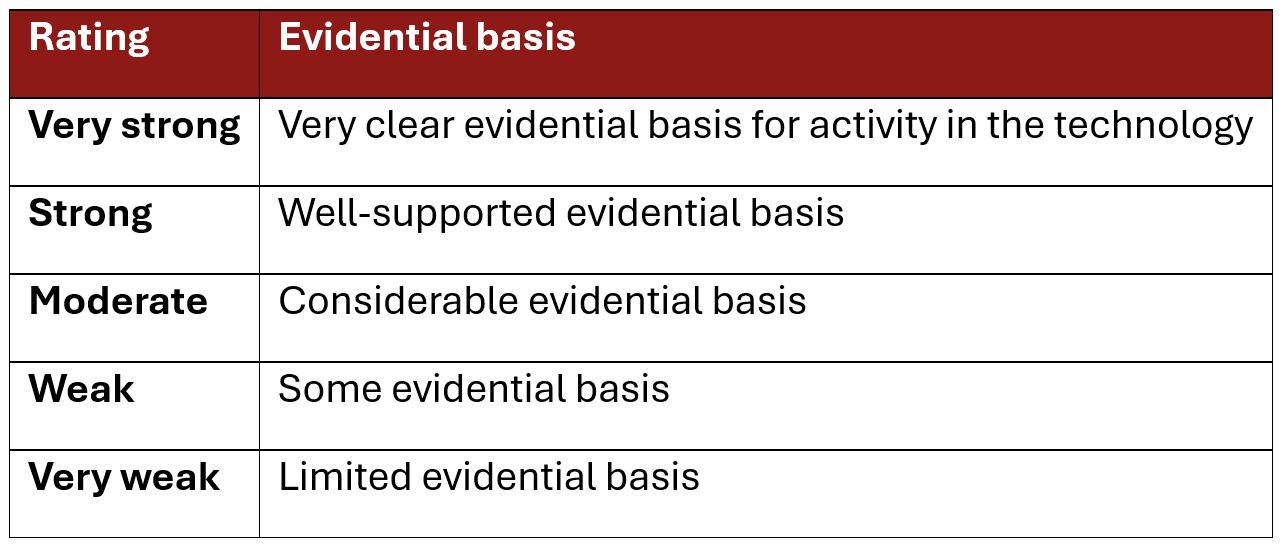
A strong or very strong rating requires a portfolio that is both clearly aligned with the technology and substantive in volume — neither dimension alone is sufficient. A company with deep alignment but few patents will be capped at a lower rating by low confidence. A company with a large patent portfolio but limited alignment to the technology will similarly be capped, regardless of its overall IP strength.
What the rating is and is not
The technology exposure rating is an evidence-based indicator, not a verdict. A very strong rating means the patent record provides a clear and well-supported basis for concluding the company is active in that technology. It does not, by itself, establish the nature or purpose of that activity — whether the technology is being developed for commercial, dual-use or explicitly military applications requires assessment of additional signals, including the company's institutional relationships, customer base, and connections identified through ASPI's China Defence Universities Tracker and Critical Technology Tracker. Equally, the absence of a rating — or a very weak rating — does not rule out activity in a technology: a company may be active in a field through means other than patenting, or may hold patents under structures not captured in the Tracker's patent data.
The technology exposure rating is derived from a composite score that combines two underlying values — an alignment score and a confidence score — for each company-technology pair in the database. The composite score is scaled to 100 and mapped to one of five rating bands.
Step 1: Alignment score. The alignment score measures the share of a company's CPC code instances that fall within the definition of a given technology. Specifically, it is calculated as:
(number of a company's CPC code instances matching the technology) ÷ (total CPC code instances in the company's portfolio)
A company whose patent activity is heavily concentrated in a single technology will carry a high alignment score for that technology. A company with a broad and diversified patent portfolio will carry lower alignment scores across any individual technology, even if it holds meaningful activity in several.
Step 2: Confidence score. The alignment score alone is not sufficient to identify activity in a particular technology — a company with two patents, both squarely in a target technology, has perfect alignment but a thin evidential base. The confidence score weights the alignment score by portfolio size and is parameterised such that it rises from zero as patent count increases, reaching 1 once a company holds 100 or more patents. It is calculated using the cumulative distribution function of the regularised Beta distribution with smoothing parameters α = 2 and β = 4. The Beta function was selected for this role because it produces a smooth, tuneable curve between 0 and 1 with no abrupt cut-off — calibrated so that meaningful confidence is not reached until the patent base is substantive. A fuller explanation of this methodological choice is set out in the FAQ entry on the regularised Beta function.
Step 3: Composite technology exposure score. The alignment and confidence scores are multiplied and scaled to produce a composite technology exposure score E out of 100:

A score of zero is possible where there is no alignment, and the maximum of 100 would require both perfect alignment and a portfolio of 100 or more patents. In practice, scores span a wide range, and the rating bands are calibrated accordingly.
Step 4: Rating bands. Each company-technology pair is assigned to one of five bands:
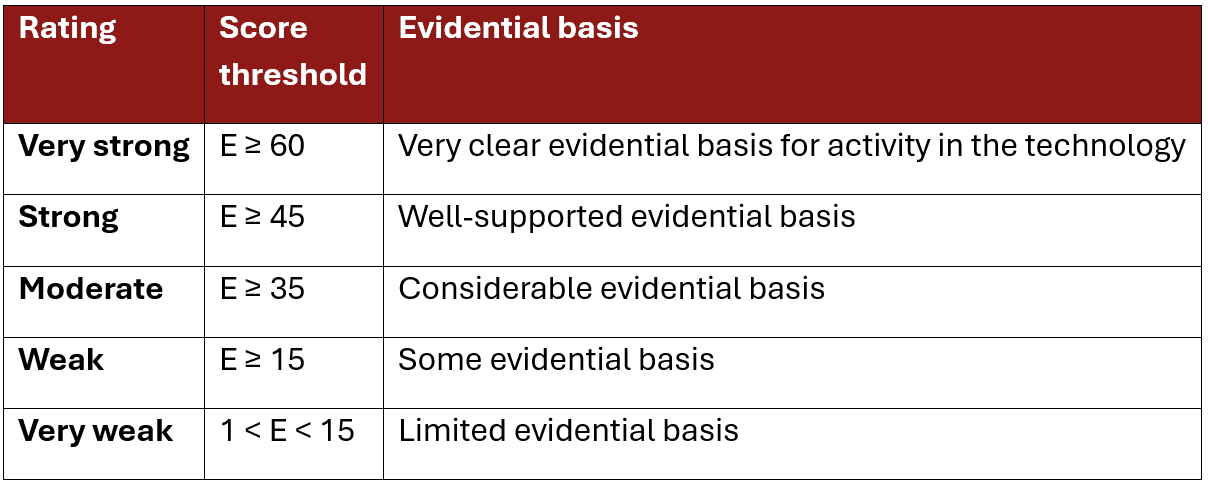
A minimum alignment score of 2% is also required for any rating to be assigned. This threshold removes the long tail of marginal associations where a company holds one or two incidental patents that technically intersect with a technology definition but do not reflect meaningful engagement with it.
Worked example:
Consider a hypothetical company, Galactic Light Solutions Co. Ltd. (GLS). GLS has 5 patents assigned to it, with the CPC codes listed in each as shown below (multiple codes on a single patent are separated by ‘|’):
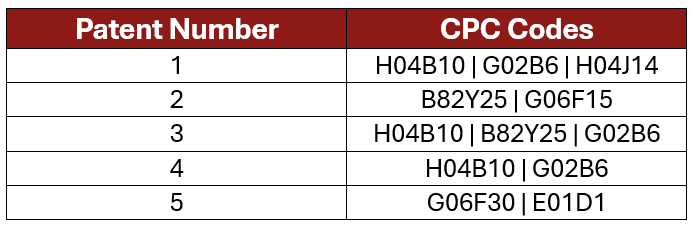
This gives 12 CPC code instances across GLS's portfolio. We then count how often each CPC code appears across GLS's patents, and identify the CTT technology (if any) it falls under:
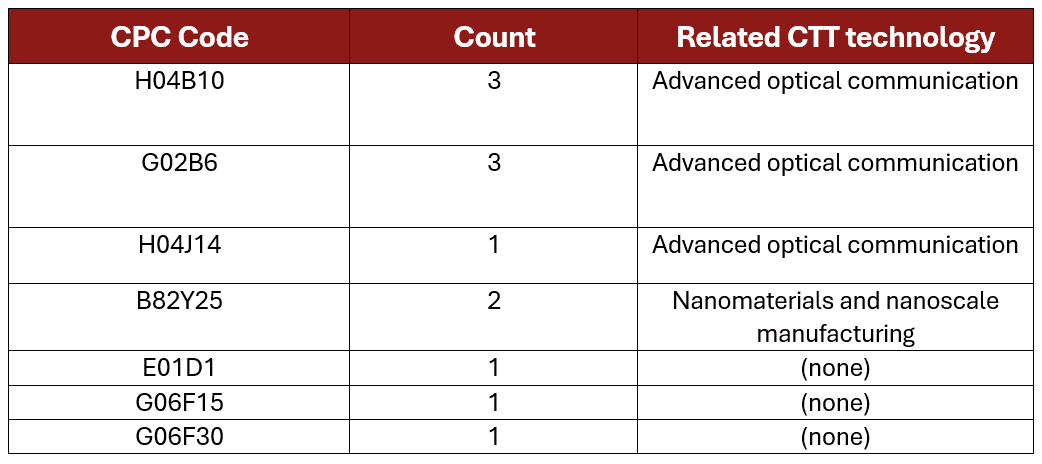
Grouping by technology and calculating the alignment score, confidence score and technology exposure score:
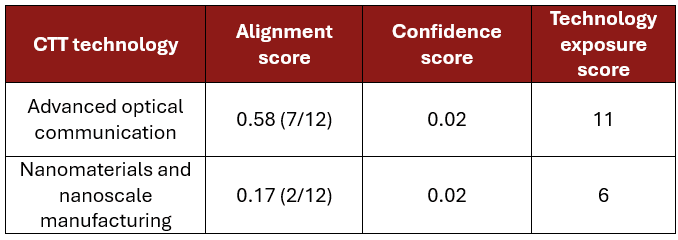
GLS has strong alignment in advanced optical communication — more than half its CPC activity maps to that technology — but its portfolio of only 5 patents produces a confidence score of 0.02, which substantially discounts that alignment. The resulting exposure scores of 11 and 6 place both technologies in the very weak band, illustrating how the confidence dimension prevents small portfolios from generating misleadingly high ratings.
The confidence score reflects how much patent data sits behind a company's alignment score. A technology exposure calculated from a large patent portfolio is more reliable than one inferred from a handful of patents, so confidence rises with portfolio size and gives more weight to better-evidenced profiles.
Turning portfolio size into a confidence weight requires a curve with a few specific properties: it should be zero when a company has no patents, rise as the portfolio grows, and reach full confidence (1) once the portfolio is large enough — climbing smoothly to that maximum rather than jumping at a cut-off. The cumulative distribution of the Beta function is a simple, well-behaved curve with exactly these properties, and its shape parameters let us control how quickly confidence builds and how it settles at the top.
The confidence score is a weighting, not a statistical confidence interval or a probability. The Beta function is used purely for its shape, not for its role in modelling proportions. It was chosen because it gives smooth, tuneable control over the full range through a single compact formula. While other sigmoid-shaped curves could in principle achieve a similar effect, the Beta function's parameterisation makes that control particularly convenient.
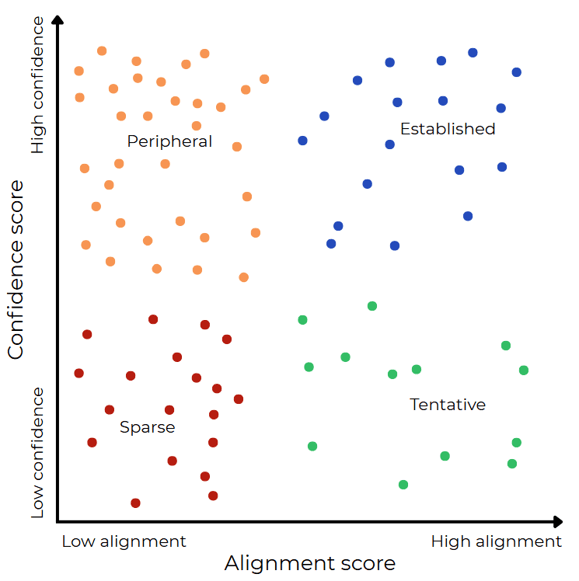
The exposure profile explains the character of a technology exposure rating. Each technology exposure rating is derived from two numbers: an alignment score and a confidence score. Plotted as a point on a two-dimensional graph (see below), the exposure profile tells you which quadrant that point falls in:
- Established – Confirmed technology exposure. The evidence is clear and well-supported. High alignment score (>=0.3), high confidence score (>=0.5)
- Peripheral – Likely technology exposure. Alignment is evident but insufficient open-source data to confirm. Low alignment score (<0.3), high confidence score (>=0.5)
- Tentative – Secondary or minor technology exposure. Data is robust but consistently points away from the technology being a primary focus. High alignment score (>=0.3), low confidence score (<0.5)
- Sparse – Possible technology exposure. Some evidence exists, but is insufficient to draw reliable conclusions. Low alignment score (<0.3), low confidence score (<0.5)
Yes, and users should be aware of two distinct reasons why this can occur.
- Taxonomy scope. The Tracker's technology classification is built on the taxonomy developed for ASPI's Critical Technology Tracker, which covers 74 technology domains selected for their defence, security and strategic significance. This taxonomy is intentionally scoped — it does not aim to cover every technology area in which a Little Giant may operate. A company active in wind turbines or advanced ceramics, for example, may hold a substantial patent portfolio in those areas without any of that activity appearing in the Tracker's classification, simply because those technologies fall outside the CTT's 74-domain scope. Where a company's Tracker classification appears sparse or absent, users should consider whether the company's primary activity may lie in a technology area the taxonomy does not cover, before drawing conclusions about the depth of its technology engagement.
This is a deliberate design choice rather than a gap. The CTT taxonomy was constructed around technologies of greatest relevance to national security, strategic competition and critical infrastructure — the domains where government, defence and investment screening users most need analytical support. Extending classification to the full breadth of Chinese industrial activity would dilute that focus. Support for additional technology taxonomies is under consideration and will be evaluated as the product develops. You can learn more about ASPI’s Critical Technology Taxonomy here. - Patent coverage. A company may also be active in a classified technology without appearing in the Tracker's classification if that activity is not well represented in its patent portfolio. Some technology areas — particularly those involving proprietary processes, trade secrets, or early-stage research that has not yet reached patentable form — may be underrepresented in patent filings relative to the company's actual capability. Additionally, patents filed under corporate structures not captured in the Tracker's patent data sources will not contribute to the classification. The technology exposure rating reflects what the patent record shows; it is not a comprehensive audit of a company's technological capabilities.
Taken together, these two limitations mean the Tracker's classification is best understood as a floor rather than a ceiling: a company with a strong technology exposure rating in a given domain has a well-evidenced patent-based footprint there, but the absence of a rating does not rule out meaningful activity. Users conducting high-stakes due diligence should treat the Tracker's output as one input into a broader assessment rather than a definitive characterisation of a company's technology profile.
Each company in the Tracker is treated as its own entity, classified according to the name recorded in official Little Giant announcements. Companies are not consolidated across subsidiaries, parent entities, merged firms, or restructured corporate groups — each legal entity is assessed on a standalone basis.
This is a deliberate methodological boundary, not an oversight. Systematically mapping the full ownership structures, restructuring histories and corporate group relationships of nearly 20,000 companies would make consistent classification impossible to maintain at scale. The standalone entity approach ensures the Tracker's coverage is uniform, reproducible and grounded in verifiable official sources.
Users should understand both what this means for the dataset and what it means for their own analysis.
What it means for the dataset:
A company's Tracker entry — including its technology exposure ratings, patent portfolio and nominating authority — reflects its own recorded activity and identity, not that of its corporate group. A state-owned enterprise with multiple Little Giant subsidiaries will appear as several distinct entries rather than a consolidated group profile. A company that has undergone a name change, corporate form conversion or partial restructuring may appear under its most recently recorded official name, with earlier name variations documented in the Tracker's name variation handling — described in the relevant FAQ entry.
What it means for due diligence:
The standalone approach means the Tracker will not automatically surface the full corporate context around a company. Users conducting due diligence should independently verify beneficial ownership, parent-entity relationships, subsidiary structures and any relevant restructuring history. Two cases illustrate why this matters:
- Shanghai GeneoDX Biotech Co. Ltd. (上海捷诺生物科技股份有限公司), a Batch 3 Little Giant, appears in the Tracker as a standalone entity. It is a subsidiary of China National Biotech Corporation (中国生物技术股份有限公司), which is almost entirely owned by China National Pharmaceutical Group Co. Ltd. (中国医药集团总公司) — Sinopharm — a major Chinese state-owned enterprise. A user assessing GeneoDX's independence from the Chinese party-state on the basis of its Tracker entry alone would materially understate its integration into the state-owned conglomerate structure.
- Shanghai Wingtech Electronics Technology Co. Ltd. (上海闻泰电子科技有限公司), also a Batch 3 Little Giant, illustrates a higher-stakes variant of the same problem. In 2019, Wingtech Technologies Co. Ltd., the majority shareholder of Wingtech Communications Co. Ltd., which is itself the sole shareholder of Shanghai Wingtech, acquired Dutch semiconductor manufacturer Nexperia — originally part of Philips Semiconductors. Components produced by Nexperia have reportedly been found in Russian weapons used in Ukraine, raising sanctions compliance concerns across multiple jurisdictions. In December 2024, the US added Wingtech Technologies to the Bureau of Industry and Security (BIS) Entity ist. The Tracker records Shanghai Wingtech as a Little Giant; it does not record Nexperia, its acquisition history, or the downstream compliance implications of that corporate relationship. Users relying solely on the Tracker's company-level data would not see any of this.
The Tracker is designed to be a starting point for company-level analysis, not a substitute for it. For high-stakes applications — investment screening, export licensing, sanctions compliance, supply chain risk — the Tracker's output should be treated as an initial signal that directs further investigation, not a definitive characterisation of a company's full corporate context.
Classification is based on company names as they appear in official Little Giant announcement and review lists, with two categories of adjustment applied to ensure the database accurately reflects the underlying population of designated firms.
Category 1: Transcription error corrections. Where a name in an official source appears to contain a transcription or OCR error — and where no company can be located under that name — a minimal correction is applied, subject to strict criteria. All four of the following conditions must be satisfied before any correction is made:
- No company can be found under the original name in any available source
- The corrected name is independently confirmed to be a Little Giant otherwise absent from the dataset
- The correction affects no more than two characters
- The substituted characters are visually similar to those replaced, consistent with a plausible OCR misread
For example, MIIT's Batch 2 list contains 宁波佳尓灵气动机械有限公司 — a company that could not be located in any desktop research. The near-identically named 宁波佳尔灵气动机械有限公司, differing only in the character 尓 versus 尔, was confirmed as a Little Giant absent from the dataset. All four criteria being satisfied, the corrected name was adopted.
This type of correction is rare, affecting fewer than 0.1% of companies in the dataset. It is applied conservatively because the alternative — retaining an unverifiable name — would introduce phantom entries into the database that cannot be linked to any real company.
Category 2: Name variation consolidation. More commonly, a company's recorded name varies across different official lists — between its initial designation announcement, subsequent batch announcements, and triennial review publications. These variations are consolidated to a single canonical record. Three causes account for the majority of cases.
Genuine name changes. A company may formally change its registered name during its time in the programme. Luoyang Longsheng Technology Co. Ltd., a Batch 6 Little Giant, changed its registered Chinese name from 洛阳隆盛科技有限责任公司 to 中航隆盛(洛阳)科技有限责任公司 — a change that also signals a shift in its corporate affiliations, with 中航 (AVIC, Aviation Industry Corporation of China) appearing in the new name.
Changes in corporate form. A common source of apparent name variation is the conversion of a company from a limited liability company (有限责任公司 or 有限公司) to a joint-stock company (股份有限公司), which is a standard step in preparing for a stock exchange listing. Henan Zhongyuan Roller Co. Ltd. (河南中原辊轴股份有限公司), a Batch 3 Little Giant, was previously registered as 河南中原辊轴有限公司. The underlying entity is the same; only the corporate form designation has changed.
Minor transcription or listing differences. Some variations reflect inconsistencies in how official lists record the same company name rather than any formal change. Baoji Safe Petroleum Machinery Co. Ltd. (宝鸡市赛孚石油机械有限公司), a Batch 3 Little Giant, appeared in its review list without the character 市 — which marks 宝鸡 (Baoji) as a city-level administrative unit. Its omission does not indicate a different company; it reflects inconsistent practice in how nominating authorities record location-based name elements.
Name variation consolidation is applied throughout the dataset and is materially more common than transcription corrections. The precise proportion of companies that have used an exactly consistent name across all their appearances in the programme will be disclosed at full product launch.
Access and Licensing
No. The two Trackers are distinct products with their own research focus, independent datasets and methodologies, but they are included within the same licence and are designed to be used together to inform consolidated risk assessments. Access to either Tracker includes access to both.
The Critical Technology Tracker focuses on the geostrategic implications of 74 critical technologies. The intense technology competition between the US and China can be seen playing out across all these technology domains making it vital to map where China leads, where it lags and how fast the competitive position is shifting. The China Little Giants Tracker focuses on relevant Chinese small to medium-sized enterprises, and identifies how their patent ownership maps to the technology domains tracked in the Critical Technology Tracker. This enables subscribers to identify which specific firms Beijing has designated as strategically capable, in those same technology domains — and to assess each firm's technology offering. Used together, the two Trackers allow subscribers to understand the technology focus of China’s Little Giants in those critical technologies most relevant to sharpening geostrategic competition.
Data export from the platform is not currently available. Organisations requiring programmatic access or bulk data extraction for integration with internal systems, screening tools or risk workflows should contact the sales team at sales@aspi.org.au to discuss API access options.
All licences for ASPI's Critical Technology Tracker include access to the China Little Giants Tracker and vice versa. The two products are not available as standalone licences. ASPI's China Defence Universities Tracker can be added to any licence as part of a discounted bundle, providing access to all three datasets within a single agreement.
Each seat equals one individual licence, and licences can be purchased individually or in bulk packages, with per-seat pricing decreasing at higher volumes. An organisation-wide licence is also available and applies per domain, providing unlimited access for all users under that verified email domain. This licence includes Single Sign On (SSO) integration with your IT system for seamless access.
Licences can be purchased by a single organisation or on behalf of a consortium to provide subsidised access to multiple organisations and their users. For custom licence arrangements, please contact sales@aspi.org.au with your requirements.
You can pay annually upfront by card or invoice or choose monthly instalments (card only) with an annual commitment. Use the toggle on the top right of this page to switch between monthly and annual options and pricing.
Currently, we are only offering demos to customers interested in the unlimited licence tier or with custom requirements. If this suits you, please reach out to us via sales@aspi.org.au with any requirements you have for a demo